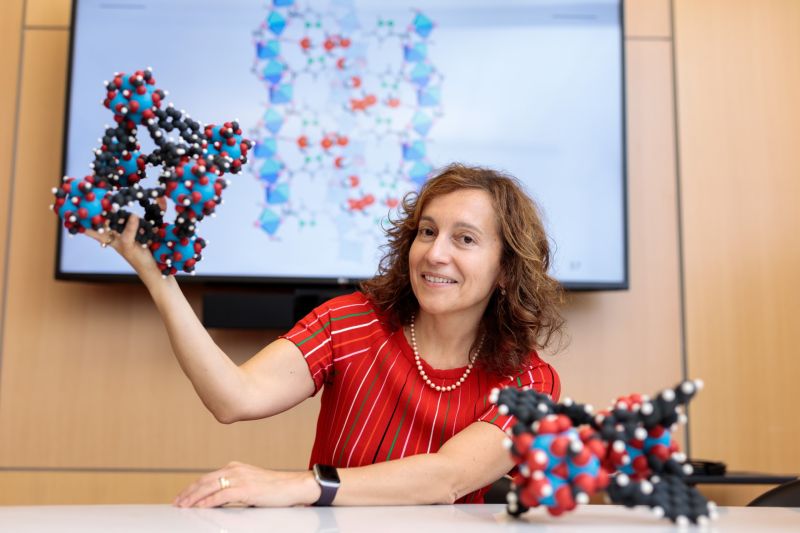
We are pleased to share a comprehensive new article showcasing the University of Chicago’s pioneering contributions to the rapidly evolving field of reticular chemistry. The piece highlights how Metal-Organic Frameworks (MOFs) and related materials are moving from serendipitous discovery to true atomic-level design—an inflection point now recognized globally following the 2025 Nobel Prize in Chemistry.
At the center of this movement is Professor Laura Gagliardi, whose theoretical and computational leadership is shaping the next generation of materials for sustainable energy and environmental impact. Her collaborations with Nobel Laureate Omar Yaghi and her direction of the DOE-funded Energy Frontier Research Center (EFRC) demonstrate how computation, synthetic chemistry, and artificial intelligence can work in tandem to accelerate breakthroughs—from more efficient atmospheric water harvesting to predictive catalyst discovery.
The article also highlights the broader UChicago ecosystem advancing the MOF frontier:
– John Anderson’s conductive, magnetic, and spintronic MOFs
– Wenbin Lin’s nanomedicine platforms for targeted cancer therapy
– Jiwoong Park’s wafer-scale MOF and COF integration for next-generation electronics
– Dmitri Talapin and Paul Alivisatos’s foundational methods for building functional nanoscale components
Together, their work illustrates how UChicago researchers are expanding the impact of MOFs across energy, medicine, catalysis, and advanced computing—while defining the future of rational materials design.
Read the full story:
“The Reticular Revolution: UChicago Chemists Move from Discovery to Design with Metal-Organic Frameworks.”